AI had the answers. I asked the better question.
I reached out to a high school friend who founded a major tech company in the 1990s and asked for his help using AI to build an app.
He warned me about a few things:
• AI can drift off track
• Patch instead of solve
• Agree when it should push back
• Give you the wrong answer faster and with more confidence
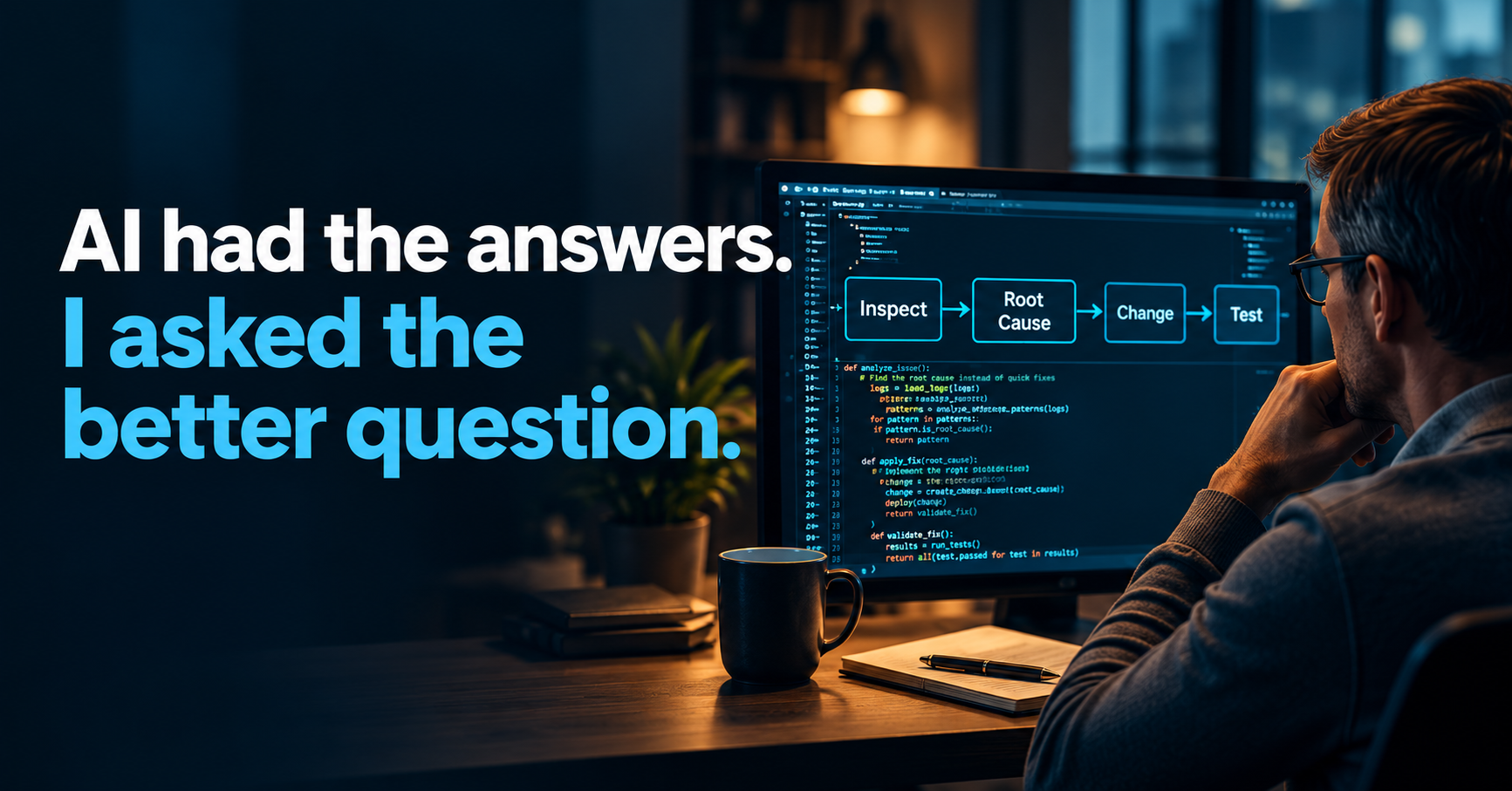
One thing surprised me: good AI coding tools don’t just fix bugs. They investigate them.
Inspect → Root Cause → Change → Test
Understand first. Then fix.
I’ve taught that kind of thinking for thirty years. It’s basically PDCA with a different name tag.
Something breaks. Someone patches it. Everyone moves on.
Three weeks later, it comes back. Same cause, different symptom.
The hard part isn’t knowing the steps. It’s having the discipline to follow them.
Guessing feels fast. Real problem solving feels slow.
But guessing doesn’t save time. It just pushes the cost downstream.
While building my app, something felt off.
So I asked AI for the root cause.
Then I pushed:
“Is there another why underneath that?”
It agreed there was.
Then:
“Why wasn’t this in place before?”
That exposed the real issue.
AI had started by reading my rules correctly, then drifted into hardcoding them instead of building the architecture to use them properly.
I had the rules. I had the thought process.
What I didn’t have was the architecture I assumed AI would build for me.
So I had to go back and rework it.
Painful lesson. Good lesson.
AI had plenty of answers. The value came from asking better questions.
The same thing happens inside companies.
A problem appears and we react:
• Reorganize
• Launch another initiative
• Add another dashboard
All reasonable responses.
The hard part isn’t reacting. It’s understanding the problem first.
You can’t expect systematic problem solving from a system that wasn’t built systematically.
AI won’t replace disciplined problem solving.
It will expose the lack of it faster, at greater scale, and with more confidence.
The tool changed. The discipline didn’t.
The advantage isn’t better AI. It’s better questions.
Even when the intelligence helping you is artificial.
Your insights and perspectives are valuable—please share your thoughts in the comments below.
To leave a comment: Press Post Comment and Okay. Enter your Comments and press Post Comment.
Enter your name or initial (you do not need to provide an email or URL) and click Comment as Guest to post.